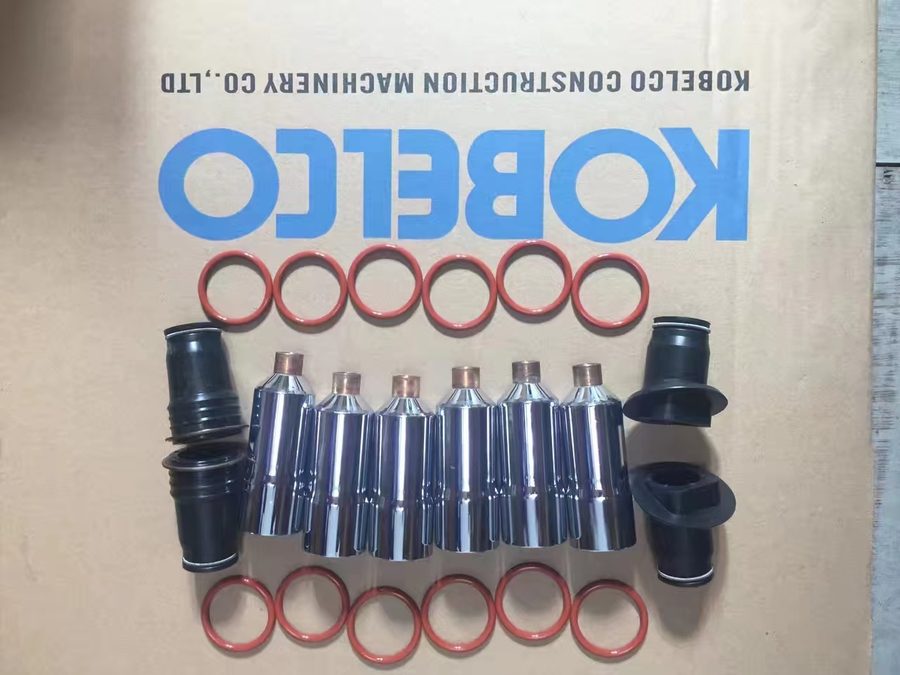
When a hydraulic pump is finally opened, the story is usually the same: the housing and the drive are fine, and the wear lives in the rotary group - the pistons, cylinder block, valve plate and retainer that convert rotation into flow. That is good news for budgets, because the rotary group is rebuildable part by part, and knowing which piece has worn is the difference between a planned rebuild and a complete pump assembly. Guangzhou Shenyue Machinery Technology Co., Ltd. supplies rotary group parts for the pumps in the Kobelco range, and this post explains how the group wears and how each piece is quoted.
What the rotary group actually is
Inside the pump housing, a rotating cylinder block carries a ring of pistons. The block's face runs against the valve plate - the flat, ported surface that directs oil in and out - and the pistons ride against an angled swash plate, which forces them in and out of their bores as the block turns. Flow comes from that clearances-tight dance; wear in any of the three contact sets - piston to bore, block face to valve plate, ball socket to retainer - shows up as the same symptom: the machine works, but slowly, and worse when the oil is hot.
How each piece wears, and what it looks like
The block face wears as fine scoring and loss of flatness, and it is the piece that most often drags the valve plate down with it. The valve plate shows a worn ring pattern rather than even contact. The pistons and their bores wear polished and slack, and the retainer's ball sockets elongate. A rotary group photographed at opening tells the whole story: our records cover the pistons separately - the HPK055K pump piston set and the HPV95 pump pistons are typical lines - so a rebuild only replaces what has actually worn. On the large pumps the same logic scales up: the HPV140 pump cylinder block and the K5V200 pump cylinder block are quoted as their own lines, as is the HPV118 valve plate. Where the wear is beyond piece-part economics, the complete assembly route exists too - the K3V180DTH-9TOV pump assembly for SK450-6 machines is in our records as a full replacement line.
Proving the pump before opening it
The rebuild decision should be made on measurements, not on age. Case-drain flow is the first test: a pump's case drain is meant to leak little, and flow that rises with hours is oil escaping past the very clearances the rotary group controls. Standby and working pressure checks come next, and the regulator is cleared first - a worn regulator mimics a worn pump at a fraction of the cost, and it is the check that saves the most money. Our guide to SK200-8 regulator faults covers that decision in detail, and the pump-and-regulator number families are mapped in our pump and regulator guide.
Hot and cold: the test that catches early wear
Run the case-drain and pressure checks twice - once on a cold morning and once after an afternoon of work. Early rotary-group wear hides behind cold, thick oil and shows itself when the oil thins, so a pump that passes cold and fails hot is telling the truth about its clearances. Logging both readings in the machine file also gives the rebuild decision a trend instead of a guess: the same pump that measures marginal today can be scheduled for a planned rebuild at the next service window, with the part numbers quoted and on the shelf before anything breaks.
Quoting a rebuild: what to send
The pump's own nameplate carries the model and serial that decide every part number - the same pump model appears across machine generations with different internals. Send the nameplate photograph with the machine model and serial, and photographs of the opened group if it is already apart, and Guangzhou Shenyue Machinery Technology Co., Ltd. quotes the worn pieces and the wear-side consumables as one list, confirmed in writing before shipping. Keep the oil itself in the argument too - abrasive oil past a tired return filter wears a fresh rotary group back to failure in half the hours, so the filter elements ride in the same order as the pistons. Every line is graded genuine, OEM or aftermarket through our original supply channels; Shenyue is an independent supplier and is not an authorized dealer of Kobelco Construction Machinery Co., Ltd., and the same quote covers 3,000+ part types on the shelf and 100,000+ part numbers available to order.
Buyers comparing pump brands and grades across fleets will find the wide-market view in our group site's guide to K3V and K5V pump brands and grades.
Frequently Asked Questions
Can I rebuild a pump with piece parts, or is a complete assembly the only safe route?
Piece-part rebuilds are the normal route when the measurements support them: pistons, valve plate and cylinder block are quoted separately precisely so that only the worn pieces are bought. The complete assembly route makes sense when the block or housing itself is damaged, when the pump is a type with poor piece availability, or when machine downtime outweighs the parts saving. Send the nameplate and the wear photographs and the quote returns both routes with numbers.
Why does the pump test weak only when the oil is hot?
Clearances grow with heat. A rotary group with early wear holds pressure against cold, thicker oil and loses it when the oil thins - which is why a cold-morning test passes and an afternoon test fails. That pairing of symptoms is the classic rotary-group signature, and it is worth confirming with case-drain flow measured both cold and hot before the pump is opened.
Do I need new O-rings and gaskets for a rebuild I am doing myself?
Yes, always. The case gaskets, shaft seals and O-rings take a set once opened, and a rebuilt pump resealed with used O-rings leaks from day one - often onto the clutch housing where it mimics an engine leak. The rebuild set ships with the piece parts as one line so the reassembly never waits on a missing seal.