A concrete batching plant or a precast yard is one of the hardest steady environments an excavator works in. The dust is abrasive, the slurry dries to cement, and the machine is washed down with water every day. None of that shows up as one big failure - it shows up as filters loading early, seals hardening, and electrical connectors corroding months before the same parts would quit on a clean site. Guangzhou Shenyue Machinery Technology Co., Ltd. supplies Kobelco parts to plants and yards across 30+ countries, and this post lists the parts that fail first here and the stocking logic that keeps the machine working.
The dust goes everywhere the air goes
Silica dust does not stay on the ground. It loads the engine air cleaner, it packs the hydraulic tank breather, and it shortens every filter interval on the machine. The breath filter family in our records - YN57V00010S002, YN57V00012S002, YN57V00002S010 and YN57V00005S002 - is what keeps the tank breathing without breathing in the yard; a clogged breather pressurizes the tank and pushes oil out of the seals instead. The engine side pays the same tax: every intake cycle on this site carries dust the filter has to stop, which is why element intervals shrink here even when machine hours look ordinary. The filter and lubricant lines we stock for this environment are grouped under filters and lubricants.
The engine air cleaner assembly LC11P00019F1 with element group YN11P00034R100 is the SK330-8 example: on a concrete yard the restriction indicator is checked daily, because a loaded element costs power and heats the turbo side of the story.Slurry finds the cylinder rods
Cylinders on a concrete machine work with wet cement dust on the rod, and every full-stroke cycle drags part of it through the wiper seal. The rod chrome survives the abrasion for a while; the wiper and rod seals go first, and the oil ends up milky from water intrusion in the wet season. Seal kits are the standing answer: the boom cylinder repair kit YN01V00151R300C / YN01V00151R700C in our records is the SK200-8 example - the composition of such kits is unpacked in our cylinder repair kit guide - and on plants we recommend stocking the kit for every cylinder type on the machine, not waiting for the first weep. Buyers take note - the kit grade, genuine or aftermarket, is stated on every quote from Guangzhou Shenyue Machinery Technology Co., Ltd.
Washdown discipline protects the electrics: spray the running gear and the chassis, never a direct jet at connectors, monitors or the controller box. In precast yards the machines that avoid electrical faults are the ones where washdown pressure never points at a connector face - water ingress there does not show up until months later.
Filtration is the cheapest insurance here
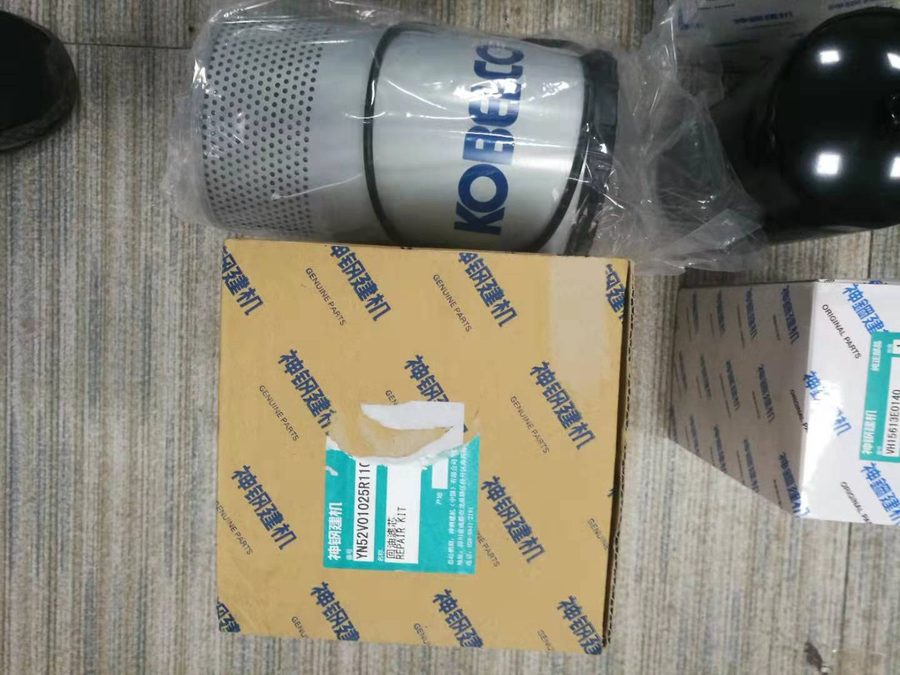
On a dusty site the return filtration does the heavy lifting: the return filter element YN52V01025R110 / YN52V01025R100 family in our records is a standing stock item for plants, because the abrasive load in the circuit rises with every slurry splash and every open-cap refill. Changing the return element on interval rather than on indication is the difference between clean hydraulics and a valve that starts sticking in the shoulder season. The suction strainer deserves the same discipline - our tank and strainer guide covers the drain and check sequence.
One caution belongs here: never crack open the hydraulic system outdoors on a dusty yard day. Fill and close under cover, wipe the cap and the filler neck, and treat every open port as a doorway for the dust the yard is full of.
Undercarriage and the drying yard
Precast yards are flat and hard, which is kind to travel drives, but the slurry packs into the track links and dries to cement overnight. Sealed and lubricated track chains resist the paste; dry chains let it set between pin and bushing and wear the joint every time the machine creeps forward. Daily travel in the drying yard also loads the sprocket segments, so segment wear is measured monthly rather than by hours alone.
The stocking list we send plant buyers
The list is short: air elements, tank breathers, return elements, cylinder seal kits, hose ends at the clamp points, and wiper seals. Guangzhou Shenyue Machinery Technology Co., Ltd. has supplied Kobelco parts since 2007, holds 3,000+ part types on the shelf and 100,000+ part numbers available to order, and quotes every line with its grade; service intervals for the machine side are published by Kobelco Japan. For buyers running mixed fleets of other makes alongside, our family site excavatorpartsglobal.com carries the wider catalog; the Kobelco-depth line stays here.
Frequently Asked Questions
Why do hydraulic tank breathers matter so much on a concrete plant?
Because the yard dust loads the breather element, a blocked breather pressurizes the hydraulic tank, and the tank then pushes oil out through every seal it can. The breath filter family YN57V00010S002 / YN57V00012S002 in our records is a standing stock item, checked on the same interval as the filters.
Which seals fail first on an excavator working in concrete slurry?
The rod wiper and rod seals on the working cylinders. Slurry on the rod is dragged through the wiper every stroke, water follows, and the oil turns milky. The boom cylinder repair kit YN01V00151R300C / YN01V00151R700C for the SK200-8 is the example in our records, and Guangzhou Shenyue Machinery Technology Co., Ltd. recommends stocking kits for every cylinder type on the machine.
How often should return filters be changed at a precast yard?
On interval, not on indication. Abrasive slurry dust raises the contamination load in the circuit, and by the time a restriction indicator calls for a change the valve clearances are already feeling it. The return filter element family YN52V01025R110 / YN52V01025R100 is quoted as genuine, OEM or aftermarket with the grade stated on the line.
Does washdown damage excavator electrics?
It can, when a direct jet points at connectors, monitors or controller boxes. Water ingress rarely shows up the same week - it appears months later as a corroded pin. Wash the running gear and chassis, keep pressure away from connector faces, and dry-fit protective caps on open connectors after any washdown.